
Tomorrow Begins With What We Build Today.
Some things are changing faster than the assumptions built around them.
What’s changing?
Live reads on where technology, teams and expectations are shifting — and what each one means for the decisions ahead.
 Live signal
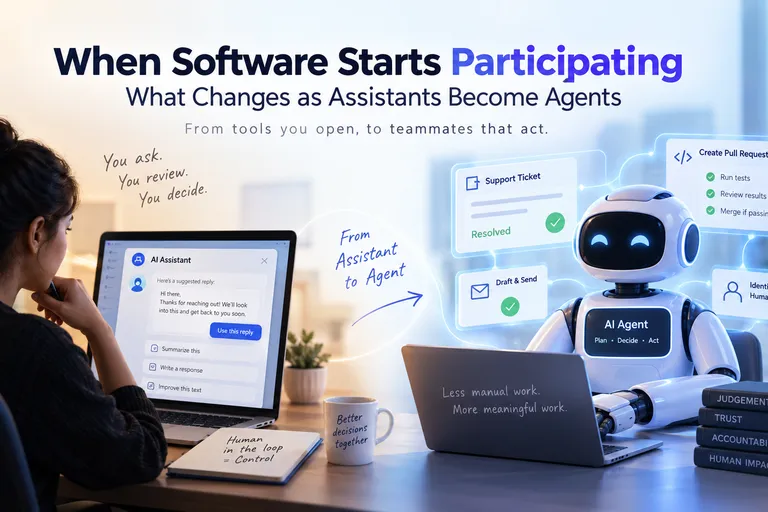
Software that participates
ObservationAssistants are becoming agents.
ImplicationThe unit of work is no longer the task but the judgement around it.
The questionWhen software does the task, what do you keep owning?
 Live signal
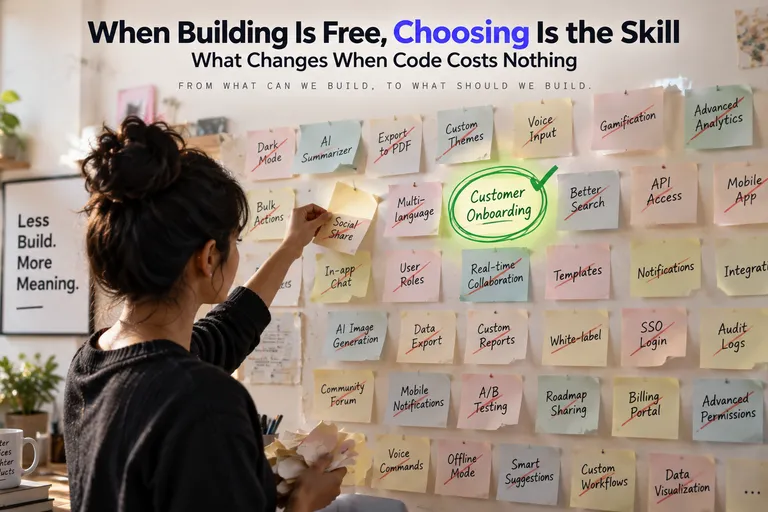
Choosing beats building
ObservationGeneration lowers the cost of code to near zero.
ImplicationThe constraint shifts from building to choosing.
The questionWhat would you stop building if making it were free?
 Live signal
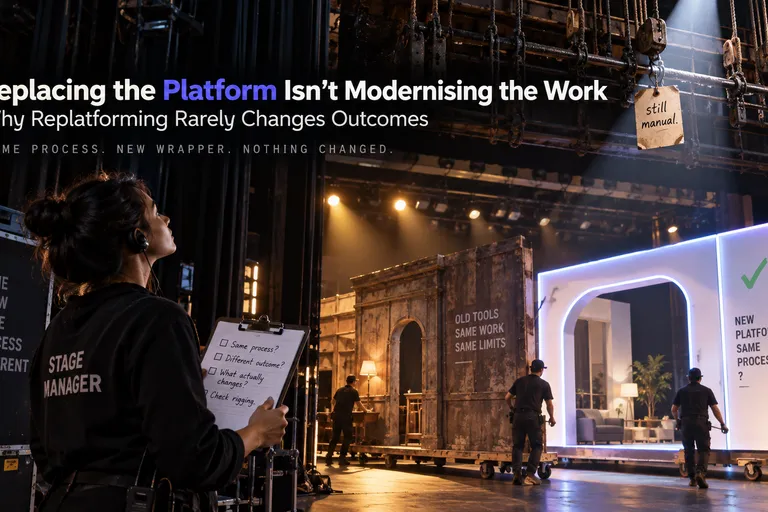
Modernise the work, not the platform
ObservationReplatforming rarely changes outcomes.
ImplicationThe legacy is often the process, not the platform.
The questionAre you modernising the system or the assumption that the work must exist at all?
 Live signal
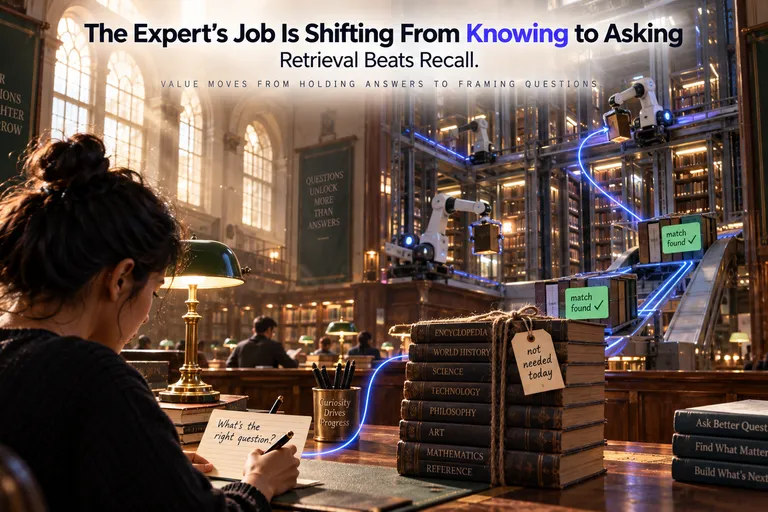
Experts who ask, not answer
ObservationRetrieval beats recall.
ImplicationLeverage comes from framing, not from holding the knowledge.
The questionWhich of your experts are underused as question-designers?
 Live signal
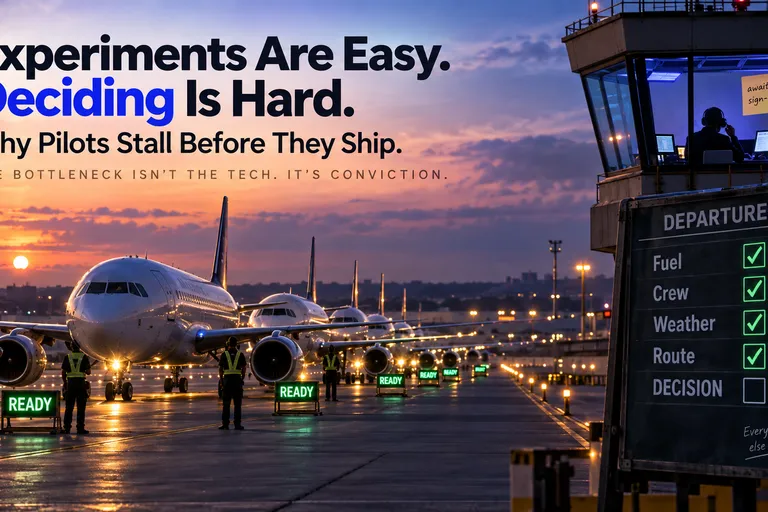
Conviction is the bottleneck
ObservationPilots are easy; conviction is rare.
ImplicationOrganisations stall at the last mile of trust.
The questionWhat would let you act on what you already know?
 Live signal
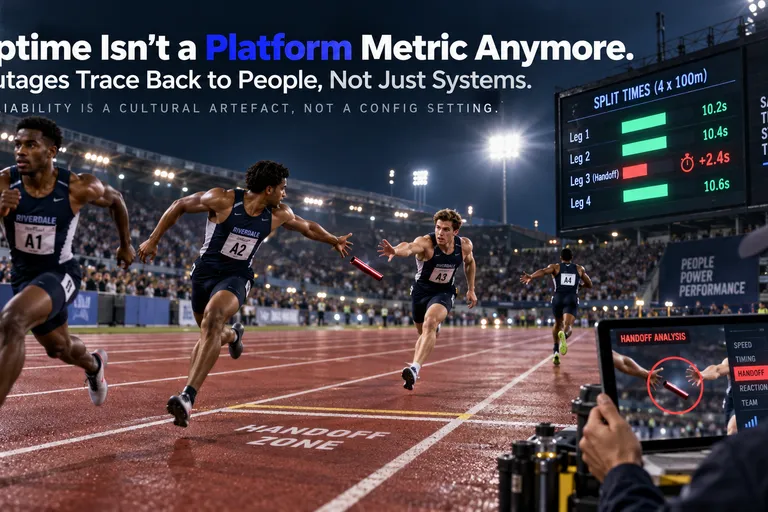
Reliability is cultural
ObservationOutages trace back to handoffs and incentives.
ImplicationUptime is a cultural artefact.
The questionWhere does your structure quietly permit failure?
Where things get interesting.
AIOrganisationEveryone wants AI. Few want to redesign the work.
Everyone wants AI. Few want to redesign the work.
The technology arrives faster than the willingness to change what people do. Adoption stalls not on capability but on the politics of rearranging responsibility.
SpeedControlMove faster. Without losing control.
Move faster. Without losing control.
Velocity and governance are treated as opposites, so teams trade one for the other. The interesting work is making control a property of the system, not a checkpoint in front of it.
LegacyChangeThe system is old. The business still needs it.
The system is old. The business still needs it.
Legacy isn't a technology problem; it's a continuity problem. You can't stop the business to replace the thing the business runs on — so the question is how to change without a pause.
InnovationExecutionIdeas are abundant. Finished outcomes are not.
Ideas are abundant. Finished outcomes are not.
The scarce resource is not imagination or even capital — it is the disciplined ability to carry an idea to something running in production that people rely on.
DataJudgementYou have more data than ever. You decide less clearly than before.
You have more data than ever. You decide less clearly than before.
Information without a frame produces anxiety, not insight. The bottleneck moves from access to interpretation — from having the number to knowing the question it answers.
The old defaults don’t hold.
Automating the process you already have
Questioning whether that process should exist at all
Speed hides a bad process well. Before automating anything, ask what you'd design if you were starting today — automation should serve that answer, not the old one.
Tracking delivery by hours logged and tickets closed
Tracking technology by the value it actually created
Effort is easy to measure and easy to mistake for progress. Throughput can rise for years while nothing changes for the business it's meant to serve.
Treating AI as a feature bolted onto existing software
Treating AI as part of who makes which decision
Adding a model changes an interface. Letting software participate in judgement changes the org chart — quietly, and usually before anyone decides it should.
Modernisation as a project with a start and an end date
Modernisation as a standing capability, never finished
A system replaced once will need replacing again. The organisations that stop feeling this pain build the ability to change continuously, not a bigger one-time project.
Defining reliability as the uptime of your systems
Defining reliability as a property of how your teams work
Systems rarely fail on their own. Look back far enough and most outages trace to a handoff, an incentive, or a structure — not a server.
What becomes possible?

New business models
New products, platforms and ways of creating value — not just cheaper versions of what exists.

Radical simplicity
Less process, less friction and less technology that exists only because of yesterday.
Intelligence at scale
Expertise and decision intelligence available where the work happens, not locked in a department.

Faster reinvention
An organisation able to change without starting from zero each time.

Better human work
Less repetitive friction. More room for judgement, creativity and relationships.

More room to experiment
Lower cost of trying, learning and changing direction — so being wrong is cheap and being right is fast.
The organisations that win won’t simply adopt what’s next.They’ll rethink
what comes next.
What’s on your mind?
Worth asking
What are you still doing because nobody has questioned it?
Some of the most consequential opportunities begin as uncomfortable questions. Bring us yours.