
When Software Starts Participating: What Changes as Assistants Become Agents
As AI moves from suggesting to doing, the design question isn't what it can automate — it's what judgement you deliberately choose to keep for yourself.
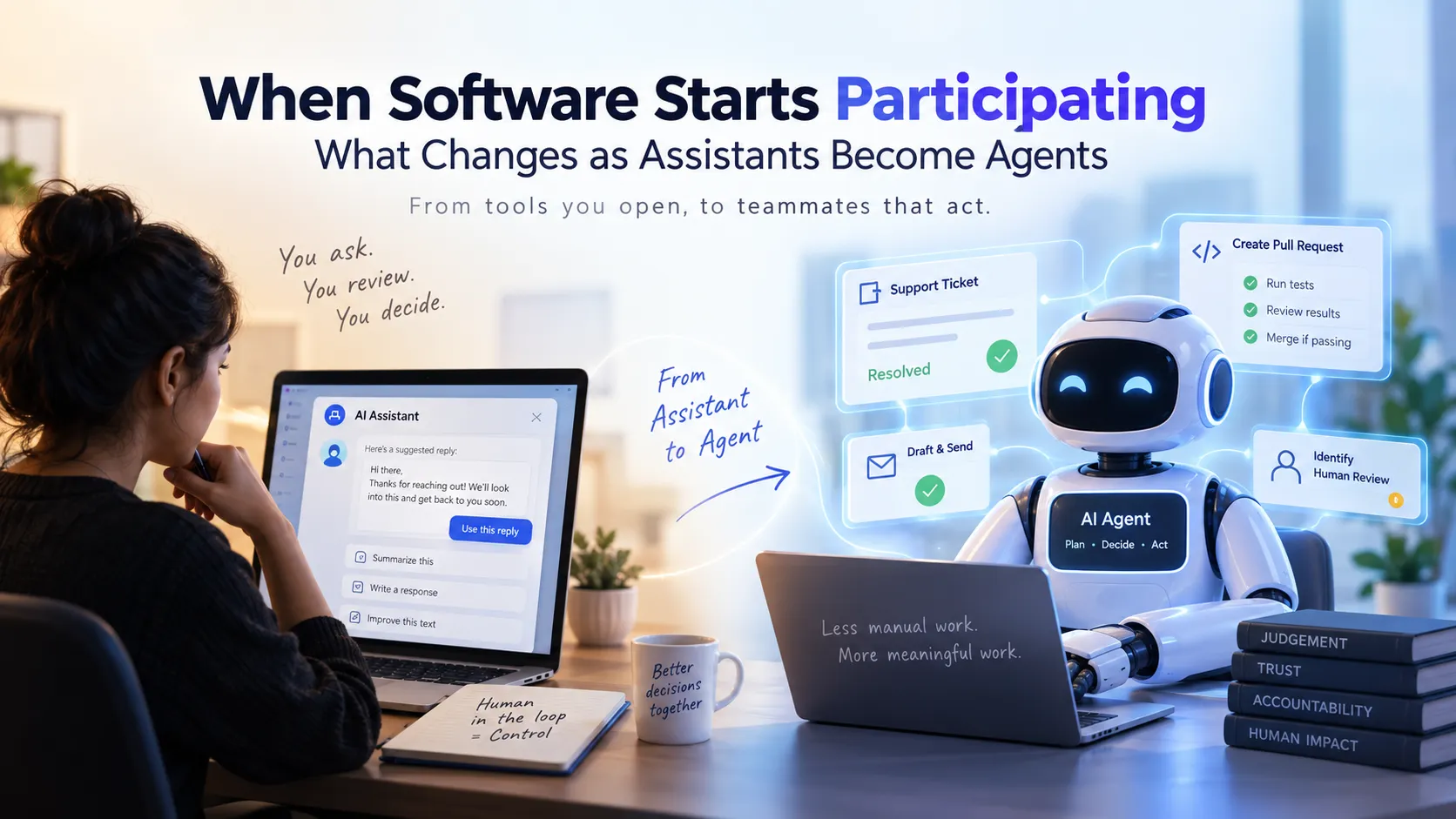
For a few years, "AI in the workflow" meant a tool a person opened on purpose: a chat window, a suggestion panel, an autocomplete. Someone decided when to ask, and someone reviewed the answer before it went anywhere. That boundary is dissolving. Increasingly, the software doesn’t wait to be asked — it decides which tickets need a human at all, drafts the response, and in a growing number of cases, sends it.
From tool to teammate
The shift from assistant to agent is easy to describe and easy to underestimate. A support assistant used to draft replies for a human to approve. An agent decides which replies need approving in the first place. A code assistant used to suggest a function; an agent opens the pull request, runs the tests, and merges if they pass. The technology did not change category so much as it changed who holds the pen last.
The unit of work has moved
When a system only executes what it’s told, the constraint is capacity — how much can get done. When a system decides what to do, the constraint becomes judgement — which decisions get delegated, under what conditions, with what recourse when it’s wrong. That is a different kind of scarcity, and most organisations are still resourced for the first one.
What you keep owning
The useful exercise isn’t listing what an agent can technically do. It’s deciding, in advance, which categories of judgement stay with a person regardless of capability:
- Decisions that are expensive or impossible to reverse.
- Decisions where "success" isn’t clearly defined yet — you’re still learning what good looks like.
- Decisions that set precedent for how similar cases get handled later.
- Decisions where the cost of being confidently wrong outweighs the cost of being slow.
The question worth asking
Not "can this be automated" — almost everything, eventually, can. The question that actually shapes an organisation is narrower: when software does the task, what do you keep owning? Answer that deliberately, and agentic AI becomes leverage. Leave it unanswered, and it becomes a slow, unplanned transfer of judgement to whichever system happened to ship first.
Ready to put these insights into practice?
Let's discuss how we can help you achieve similar results