
The New Scarcity: Judgement, Not Code
When building is nearly free, the organisations that win aren't the ones shipping the most — they're the ones that know exactly what not to build.
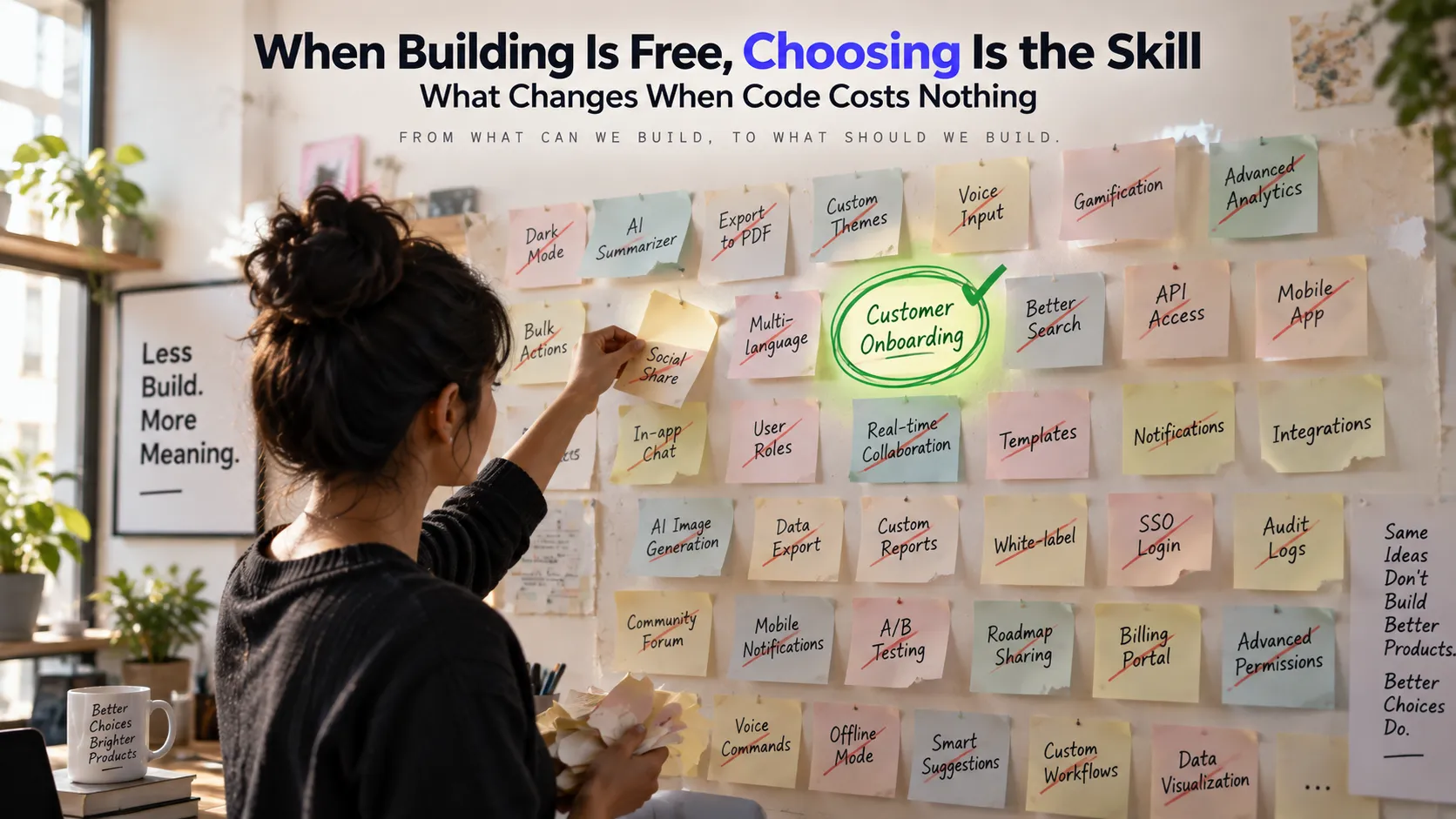
Generation has made the old strategic question — can we build this? — almost always answerable with yes. A prototype that once needed a sprint now needs an afternoon. That sounds like unlocked potential, and in part it is. It’s also removed the one filter that used to force prioritisation: cost.
Abundance changes the question
When supply is scarce, you ration it, and rationing forces discipline. When supply is abundant, the scarce resource moves upstream — from the ability to build to the judgement about what deserves to exist. Teams that don’t make that shift explicitly tend to keep behaving as if building were still the hard part, and end up with more shipped, half-adopted things than they can maintain.
Three questions that matter more than “can we build it”
- Does this remove a real constraint someone is working around today, or does it add a new option nobody asked for?
- Who will still be relying on this in six months, and are they in the room deciding to build it?
- What do we stop maintaining to make room for this — not in theory, but by name?
The backlog is not a strategy
A backlog that only grows is often mistaken for ambition. It’s more often an absence of decisions being made about what shouldn’t happen. Cheap generation makes this worse, not better: it’s now possible to produce a plausible-looking version of almost anything before anyone has asked whether it should exist, which makes "we already built it" a weak but persuasive argument for keeping it.
The better prompt
The signal worth sitting with isn’t "what could you build if it were free" — that answer is now almost always "everything." The sharper version is: what would you stop building, or stop maintaining, if making more of it were free? That’s the question that actually reveals strategy, because it can’t be answered by capability. It can only be answered by judgement.
Ready to put these insights into practice?
Let's discuss how we can help you achieve similar results