
Delivery & Operations
Most delivery problems aren't technical. They're about who owns the decision to ship and what happens in the organisation afterwards.
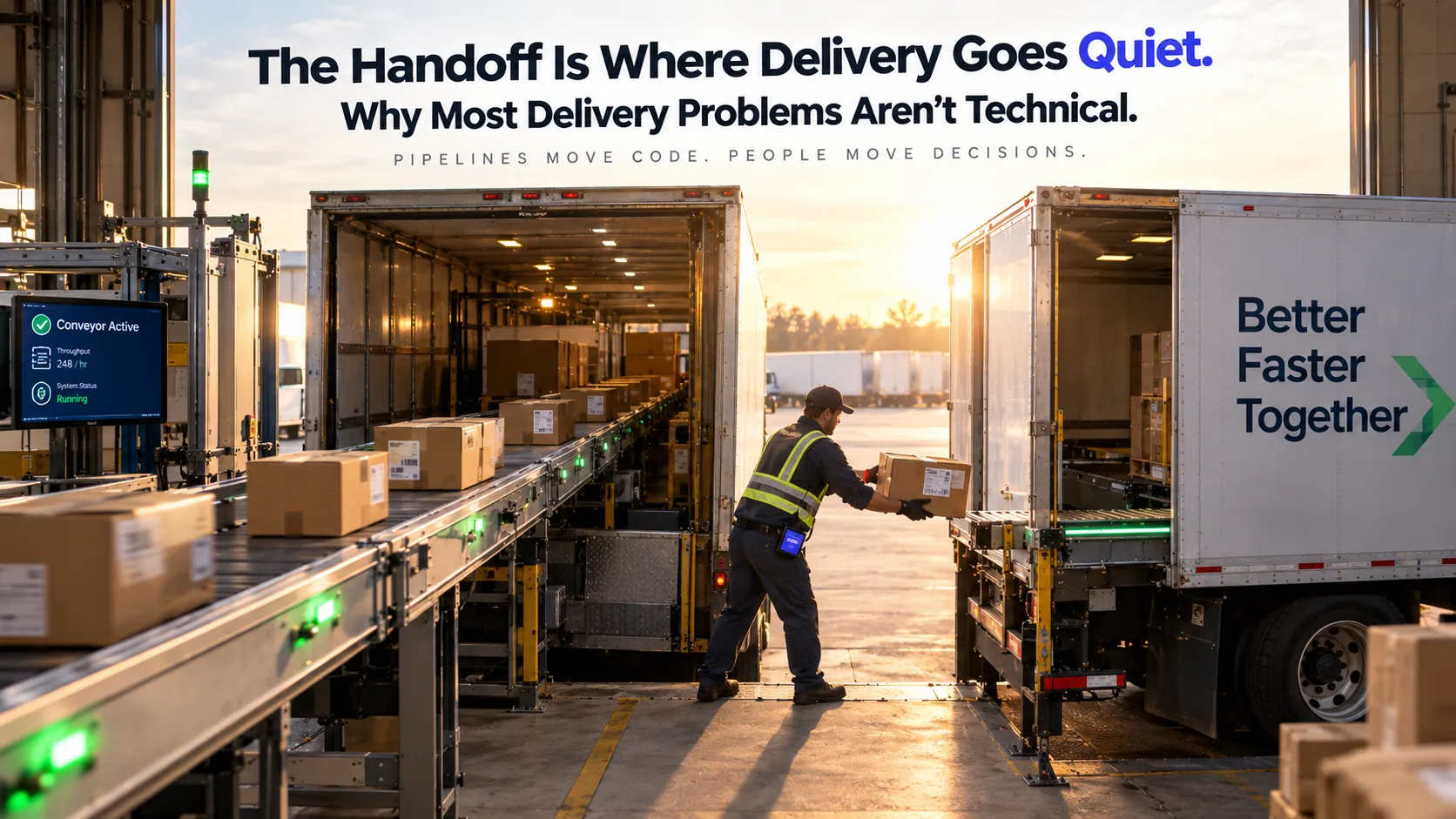
Ask most engineering leaders where delivery breaks down and they'll point at process: too many handoffs, too much ceremony, not enough automation. Ask again after the next missed date, and the real answer usually surfaces — nobody was clearly on the hook for the decision to ship, so everybody waited for someone else to make the call.
Operations is a decision system, not a pipeline
A CI/CD pipeline moves code. It doesn't decide whether code is ready, who's accountable if it isn't, or what happens the moment after release. Those are organisational questions, and no amount of tooling answers them by default. Delivery & Operations, as a discipline, is really about designing those decision points on purpose instead of discovering them mid-incident.
The handoff is where things go quiet
Nearly every delivery delay we've traced back far enough lands on a handoff: between the team that built a feature and the team that has to support it, between "it works on staging" and "someone signed off on production," between an experiment's result and the decision to act on it. Fixing the handoff is rarely glamorous, but it's where most of the time actually goes.
What operational maturity actually looks like
- A named owner for every stage of delivery, not a team, a name.
- A default answer for "who decides" that doesn't require a meeting to invoke.
- Operational learning that changes the next handoff, not just the postmortem doc.
Good delivery isn't the absence of process. It's a small number of decisions, clearly owned, made consistently enough that nobody has to reinvent them under deadline pressure.
Ready to put these insights into practice?
Let's discuss how we can help you achieve similar results