
Your Best Experts Aren't the Ones With the Most Answers
When retrieval beats recall, the most valuable people in an organisation are the ones who know which question to ask — not the ones who remember the most.
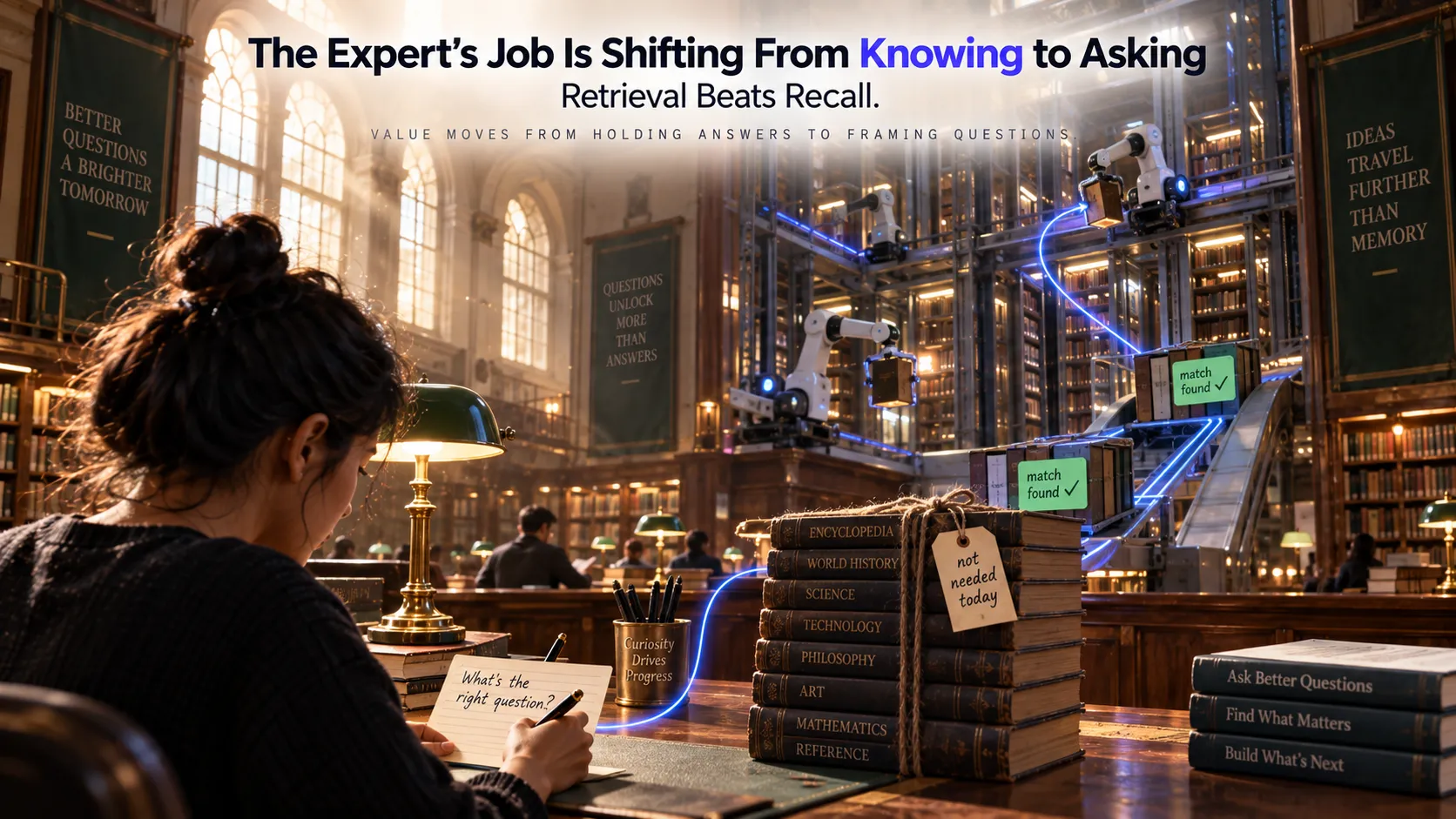
Expertise used to mean holding rare knowledge in your head and producing it faster than anyone else could look it up. That was genuinely valuable when looking things up was slow. It’s a shrinking advantage now that retrieval — search, internal knowledge systems, AI-assisted lookup — can surface most factual answers in seconds, for anyone, regardless of tenure.
Recall was never the scarce skill
What made a senior person’s answer better wasn’t usually that they remembered a fact junior colleagues didn’t — it was that they knew which fact mattered, which context to apply it in, and which question the situation actually required. That skill, framing, doesn’t depreciate when retrieval improves. If anything it becomes more visible, because the easy part — finding information — stops being where the differentiation lives.
The quiet demotion of the question-designer
Most organisations still reward the visible, easy-to-measure version of expertise: who answered fastest, who closed the most tickets, who was in the room with the "right" answer. The person who reframed a badly-posed problem before it wasted three weeks rarely gets credited for the weeks that were never lost. That mismatch means real leverage often goes unrecognised, and eventually underused.
Where this leverage is hiding
- The person everyone quietly routes exceptions to, even when it’s not their job.
- The person whose meetings tend to end with a sharper question rather than a fast decision.
- The person who reframes a support ticket or a brief before escalating it — and the escalation goes away.
A different kind of org design
If retrieval keeps improving — and it will — the organisations that benefit most won’t be the ones with the deepest institutional memory. They’ll be the ones that deliberately identify their question-designers, put them upstream of decisions instead of downstream of them, and stop measuring expertise purely by how fast someone had an answer.
Ready to put these insights into practice?
Let's discuss how we can help you achieve similar results